
Labor Market StudyNovember 202612 min read
Entry-Level Careers Surviving AI in 2026: Best Zero-Experience Roles Ranked by Growth and Pay
We audited 1,086 zero-experience occupations across ILO AI exposure and BLS 2025–2035 projections: 32 high-AI clerical on-ramps are shrinking fast, while 242 low-AI entry roles are growing at 3% or faster.
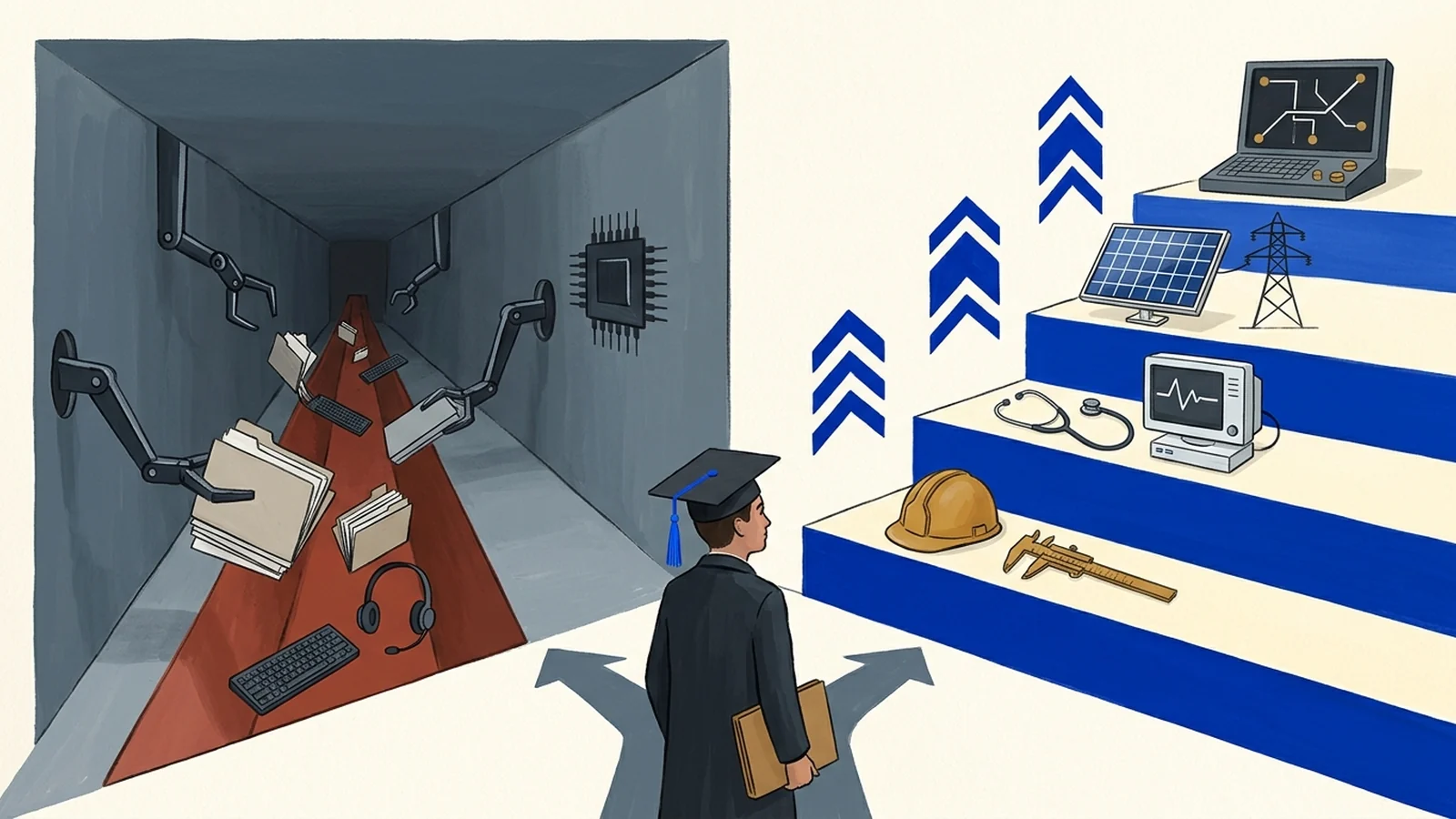
Entry-level work is splitting in two. In our 2026 labor market audit of 1,086 zero-experience occupations, 896 carry official U.S. wage and ten-year employment projections through 2035. Within that group, 242 low-AI entry roles are projected to grow by 3% or faster, while 32 high-AI clerical and support on-ramps are actively shrinking.
The dividing line is straightforward: starter jobs built around typing, routing calls, or keying structured records are losing headcount fast, while roles anchored in physical machinery, clinical care, field inspection, and operational accountability are expanding. Word processors and typists face a projected 34.4% decline by 2035, switchboard operators fall 26.0%, and data entry keyers drop 25.5%. Over the same decade, industrial machinery mechanics grow 17.8%, diagnostic medical sonographers grow 13.9%, and occupational health and safety specialists expand 18.5%, with median pay from $64,520 to $96,590.
At a glance: fastest-shrinking vs. fastest-growing entry paths
| Occupation | 2025–2035 direction | 2025 median pay | 2025–2035 growth | ILO AI exposure | Entry education |
|---|---|---|---|---|---|
| Word processors and typists | Contracting | $49,280 | -34.4% | 60% | High school diploma |
| Switchboard operators | Contracting | $38,630 | -26.0% | 49% | High school diploma |
| Data entry keyers | Contracting | $41,340 | -25.5% | 68% | High school diploma |
| Occupational health and safety specialists | Expanding | $90,150 | +18.5% | 28% | Bachelor's degree |
| Industrial machinery mechanics | Expanding | $64,520 | +17.8% | 20% | High school diploma |
| Diagnostic medical sonographers | Expanding | $96,590 | +13.9% | 20% | Associate's degree |
How we audited 1,086 zero-experience occupations
Most commentary on junior hiring generalizes from a handful of tech companies. To measure the wider entry-level market, we started with ESCO v1.2.1 and isolated occupations mapped to O*NET Job Zones 1 and 2 that require zero prior years of experience at entry. That screen returned 1,086 zero-experience occupations.
We cross-referenced those titles against task-level generative AI exposure scores from International Labour Organization Working Paper 140 and ten-year wage, openings, and employment forecasts from the U.S. Bureau of Labor Statistics 2025–2035 Employment Projections. Exactly 896 of the 1,086 roles matched full BLS wage and growth records.
Using strict cutoffs, we separated the two poles of the market. Low-AI growing roles combine ILO generative AI exposure of 35% or lower with projected 2025–2035 growth of at least 3%, yielding 242 occupations. High-AI contracting roles combine AI exposure of 45% or higher with negative ten-year growth, isolating 32 shrinking occupations. Rather than dumping all 1,086 titles into an unreadable directory, the shortlists below cover the 10 fastest-shrinking clerical roles and 24 resilient, growing entry paths across three education tiers.
The 10 high-AI entry-level roles contracting fastest through 2035
Clerical, intake, and call-handling desks once gave new entrants a reliable first rung into white-collar employment. Those roles now absorb the sharpest contraction. Recent empirical research from the Stanford Digital Economy Lab points in the same direction, documenting early-career hiring pullbacks concentrated in occupations with heavy generative AI task overlap.
2025–2035 BLS Projected Employment Change (%)
Shrinking High-AI Entry Roles vs. Resilient Growing Entry Roles
Fastest-contracting entry roles
2025–2035Word processors & typists
AI 60% · $49.3k
Switchboard operators
AI 49% · $38.6k
Data entry keyers
AI 68% · $41.3k
Telemarketers
AI 52% · $35.5k
Payroll & timekeeping clerks
AI 55% · $58.3k
Bank tellers
AI 58% · $43.0k
Fastest-growing resilient entry roles
2025–2035Occupational health & safety
AI 28% · $90.2k
Industrial machinery mechanics
AI 20% · $64.5k
Logisticians
AI 38% · $82.3k
Diagnostic medical sonographers
AI 20% · $96.6k
Industrial engineers
AI 32% · $102.4k
Electrical power-line repairers
AI 20% · $95.3k
Every occupation in the 10 steepest declines sits between 49% and 68% ILO generative AI exposure, and all 10 require a high school diploma or less (nine list a high school diploma or equivalent, and telemarketers list no formal credential). Their core tasks center on transcribing text, routing phone calls, reconciling standardized forms, and reading scripted outreach lines. As software handles document intake and first-pass verification at near-zero marginal cost, employers cut junior seats while keeping output flat.
| Occupation | 2025 median pay | 2025–2035 growth | Annual openings | ILO AI exposure | Entry education |
|---|---|---|---|---|---|
| Word processors and typists | $49,280 | -34.4% | 1,900 | 60% | High school diploma |
| Switchboard operators, including answering service | $38,630 | -26.0% | 3,100 | 49% | High school diploma |
| Data entry keyers | $41,340 | -25.5% | 7,700 | 68% | High school diploma |
| Telemarketers | $35,450 | -21.4% | 5,800 | 52% | No formal credential |
| Payroll and timekeeping clerks | $58,260 | -15.9% | 11,400 | 55% | High school diploma |
| File clerks | $43,600 | -15.8% | 5,600 | 49% | High school diploma |
| Tellers | $43,030 | -13.2% | 26,800 | 58% | High school diploma |
| Interviewers, except eligibility and loan | $45,920 | -10.4% | 13,200 | 55% | High school diploma |
| Bill and account collectors | $47,030 | -10.4% | 11,200 | 51% | High school diploma |
| Brokerage clerks | $65,750 | -7.6% | 3,400 | 64% | High school diploma |
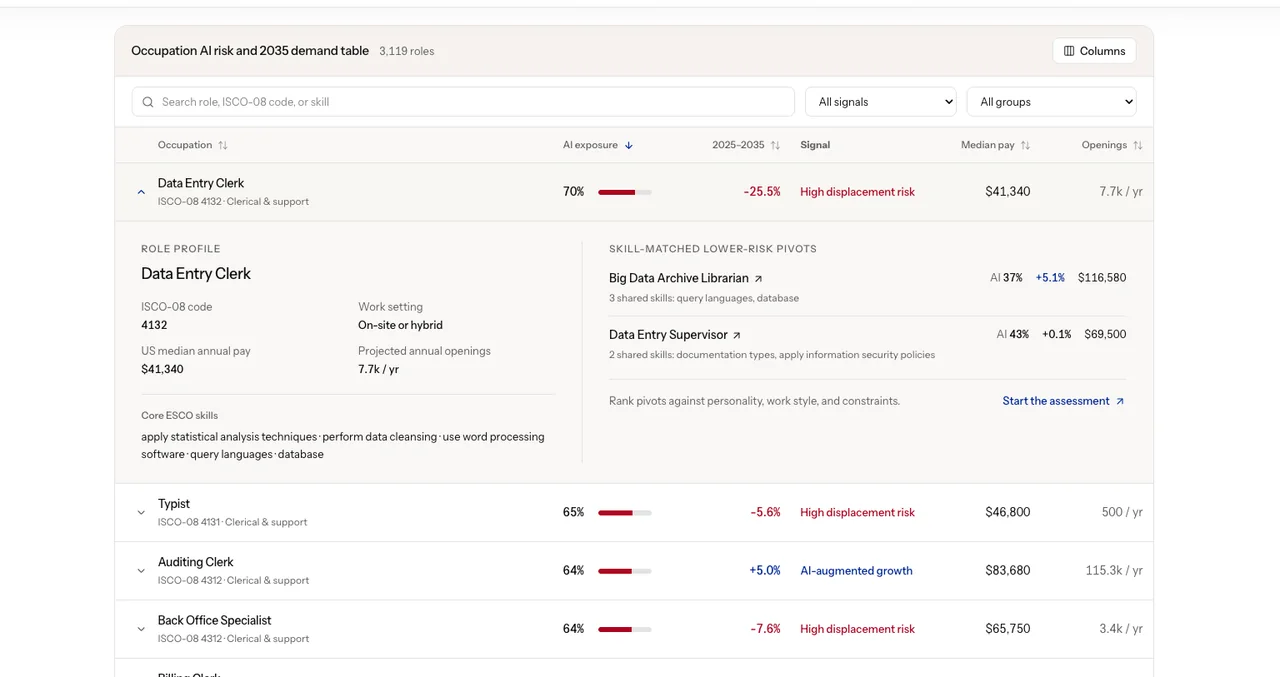
Active job postings can mask this decline. Bank tellers show 26,800 projected annual openings on a 2025 employment base of 339,200 workers, and interviewers show 13,200 openings a year. Almost all of that hiring replaces departing staff rather than adding seats. Joining a shrinking team limits internal promotion paths and leaves you exposed to each new wave of workflow automation.
Before accepting an administrative or intake role, run the title through the CareerPine AI job risk checker to inspect its task exposure beside ten-year projections. If you already work in one of these clerical jobs, our skill-matched career pivots analysis maps how tellers, administrative staff, and bookkeepers move into compliance, logistics, and project coordination without resetting their careers.
Tier 1: High-paying entry roles with a high school diploma or apprenticeship
Applicants without a college degree find their highest pay and demand floor in utility infrastructure, industrial maintenance, and skilled trades. Across the top eight resilient occupations in this tier, median wages run from $63,800 to $95,320, projected growth ranges from +4.1% to +17.8%, and ILO AI exposure stays between 17% and 32%.
| Occupation | 2025 median pay | 2025–2035 growth | Annual openings | ILO AI exposure |
|---|---|---|---|---|
| Electrical power-line installers and repairers | $95,320 | +10.3% | 10,900 | 20% |
| First-line supervisors of construction trades and extraction workers | $79,920 | +5.0% | 67,000 | 29% |
| First-line supervisors of mechanics, installers, and repairers | $79,860 | +4.1% | 48,900 | 21% |
| Control and valve installers and repairers, except mechanical door | $74,340 | +4.3% | 3,600 | 18% |
| Food service managers | $69,390 | +5.8% | 38,800 | 32% |
| Mobile heavy equipment mechanics, except engines | $65,510 | +6.7% | 15,000 | 17% |
| Industrial machinery mechanics | $64,520 | +17.8% | 44,400 | 20% |
| Plumbers, pipefitters, and steamfitters | $63,800 | +6.8% | 42,000 | 17% |
Two practical caveats belong next to these numbers. First, BLS records minimum formal schooling separately from workplace progression. First-line supervisors of construction trades ($79,920), mechanic supervisors ($79,860), and food service managers ($69,390) list a high school diploma as the typical education credential, yet employers promote into them after hands-on field, shop, or shift progression. Treat those titles as the built-in advancement ceiling for trade apprentices and floor leads rather than Day-1 postings.
Second, the true zero-experience entry points in Tier 1 require physical resilience and structured apprenticeships. Electrical power-line installers ($95,320) work at height during storm outages after utility apprenticeship training. Industrial machinery mechanics (+17.8%, 44,400 annual openings) repair factory robotics, hydraulics, and conveyors; as manufacturing plants automate more assembly lines, demand rises for the technicians who keep physical hardware running. Plumbers, pipefitters, and steamfitters (42,000 openings) and mobile heavy equipment mechanics ($65,510) offer earn-while-you-learn pathways in exchange for physical labor, outdoor sites, and strict safety standards.
Tier 2: Resilient entry roles via certificate or two-year associate degree
Short technical certificates and two-year associate degrees deliver the strongest pay-to-risk ratio in our entire audit. All eight roles below hold ILO generative AI exposure between 15% and 26%, project +4.0% to +13.9% growth through 2035, and pay a median wage between $79,870 and $123,220.
| Occupation | 2025 median pay | 2025–2035 growth | Annual openings | ILO AI exposure | Entry education |
|---|---|---|---|---|---|
| Commercial pilots | $123,220 | +5.2% | 5,200 | 23% | Postsecondary nondegree award |
| Dental hygienists | $98,100 | +8.0% | 15,000 | 15% | Associate's degree |
| Diagnostic medical sonographers | $96,590 | +13.9% | 6,000 | 20% | Associate's degree |
| Magnetic resonance imaging technologists | $95,480 | +7.7% | 2,300 | 20% | Associate's degree |
| Captains, mates, and pilots of water vessels | $92,460 | +4.0% | 3,800 | 26% | Postsecondary nondegree award |
| Respiratory therapists | $82,280 | +8.5% | 8,600 | 26% | Associate's degree |
| Radiologic technologists and technicians | $80,110 | +5.0% | 13,000 | 20% | Associate's degree |
| Aircraft mechanics and service technicians | $79,870 | +5.4% | 11,400 | 23% | Postsecondary nondegree award |
Physical precision combined with regulatory sign-off insulates these roles from automation. Software can draft clinical notes or highlight suspicious tissue on a finished scan, yet it cannot position a patient inside an MRI bore, guide an ultrasound probe across live anatomy, perform periodontal scaling, or legally certify an aircraft engine return to service.
Still, shorter schooling never means an effortless shortcut. Every occupation in Tier 2 enforces strict licensing, training hours, or clinical bottlenecks:
- Aviation and maritime credentials: Commercial pilots ($123,220) need FAA ratings, logged flight hours, and steep upfront flight-school financing. Vessel captains, mates, and pilots ($92,460) advance through verified sea time and maritime licensing exams. Aircraft mechanics ($79,870) typically finish an FAA-approved maintenance program to earn Airframe and Powerplant certification.
- Clinical rotations and state boards: Dental hygienists ($98,100, lowest AI exposure here at 15%), diagnostic medical sonographers ($96,590, fastest growth in Tier 2 at +13.9%), MRI technologists, radiologic technologists, and respiratory therapists all require accredited programs, supervised clinical hours, and licensing exams. Public community colleges offer strong return on tuition, though selective waitlists are common.
Tier 3: Resilient entry roles requiring a bachelor's degree
While generic junior office tracks face tighter hiring, bachelor's-level careers tied to physical systems, regulatory compliance, clinical nutrition, or supply-chain execution show strong expansion through 2035. The eight roles below combine +7.7% to +18.5% projected growth with median pay from $76,400 to $232,140.
| Occupation | 2025 median pay | 2025–2035 growth | Annual openings | ILO AI exposure |
|---|---|---|---|---|
| Occupational health and safety specialists | $90,150 | +18.5% | 17,100 | 28% |
| Logisticians | $82,320 | +17.6% | 26,600 | 38% |
| Industrial engineers | $102,440 | +12.4% | 23,100 | 32% |
| Operations research analysts | $88,940 | +11.9% | 7,500 | 42% |
| Mechanical engineers | $104,110 | +11.2% | 17,800 | 32% |
| Electrical engineers | $120,630 | +9.9% | 11,400 | 33% |
| Airline pilots, copilots, and flight engineers | $232,140 | +8.3% | 11,200 | 24% |
| Dietitians and nutritionists | $76,400 | +7.7% | 5,700 | 34% |
Three nuances matter when reading this table. First, six of the eight roles sit at or below our 35% low-AI threshold (24% to 34%), while logisticians (38%) and operations research analysts (42%) sit in moderate AI exposure territory. Both remain on the resilient shortlist because optimization software accelerates forecasting without removing the human role in resolving freight disruptions, auditing plant bottlenecks, and owning operational trade-offs. Their +17.6% and +11.9% growth rates reflect expanding employer demand for analytical capacity.
Second, hardware and safety roles outperform broad corporate generalist paths. Industrial engineers ($102,440, 23,100 annual openings), mechanical engineers ($104,110), and electrical engineers ($120,630) support grid upgrades, power electronics, and factory expansion. Occupational health and safety specialists ($90,150) lead every table in this study at +18.5% growth because plants, warehouses, and construction sites require on-site hazard audits and legal compliance sign-off.
Third, two titles carry major requirements beyond an undergraduate degree. Airline pilots ($232,140) accumulate substantial flight hours via commercial aviation or military service and earn an Airline Transport Pilot certificate before flying for major carriers. Dietitians and nutritionists ($76,400) complete supervised clinical practice and credentialing exams, with newer U.S. registration pathways expecting graduate coursework alongside a bachelor's base.
How to vet an entry-level job posting in 2026
Before investing months into applications or tuition, run any target role through four filters:
- Check for physical, clinical, or statutory friction. Ask what breaks if a language model drafts 80% of the daily text. Jobs tied to live equipment repair, bedside diagnostics, safety inspections, or engineered hardware remain insulated because software cannot perform the physical step or carry legal sign-off.
- Separate turnover churn from real growth. High posting volume can hide a shrinking headcount pool. Bank tellers (26,800 openings, -13.2% growth) and payroll clerks (11,400 openings, -15.9% growth) backfill steady exits, whereas industrial machinery mechanics (44,400 openings, +17.8% growth) and logisticians (26,600 openings, +17.6% growth) add new seats on top of replacement demand.
- Verify the real ramp-up cost before enrolling. Check apprenticeship waitlists, flight-hour financing, community college clinical seat caps, and state board pass rates directly with local programs. A two-year sonography or dental hygiene degree often pays back faster than an unfocused four-year diploma.
- Match the daily environment to your actual temperament. A resilient trade or hospital role turns miserable fast if you dislike shift schedules, outdoor weather, sterile clinics, or strict procedures. Taking the CareerPine career personality test helps narrow resilient paths to environments that fit how you work, and our hands-on guide to the best career test websites compares how major assessment frameworks score fit.
Frequently asked questions
- Are all entry-level office jobs disappearing because of AI?
- No. Among 896 zero-experience occupations with BLS projections, 32 high-AI roles are contracting, clustered in typing, switchboard operation, data entry, telemarketing, filing, and routine clerical work. Office-based roles tied to physical logistics, engineering systems, and regulatory safety, including logisticians (+17.6%) and occupational health and safety specialists (+18.5%), are projected to grow strongly through 2035.
- What is the highest-paying entry-level career with low AI risk and no bachelor's degree?
- Among certificate and two-year associate pathways, commercial pilots lead at $123,220 median annual pay (23% AI exposure, +5.2% growth), followed by dental hygienists at $98,100 (15% AI exposure, +8.0% growth) and diagnostic medical sonographers at $96,590 (20% AI exposure, +13.9% growth). Among high school and apprenticeship pathways, electrical power-line installers and repairers top the list at $95,320 (20% AI exposure, +10.3% growth).
- Why do shrinking jobs like bank teller still show thousands of annual openings?
- BLS annual openings combine net job growth with replacement demand from retirements and career exits. Bank tellers still generate 26,800 projected openings per year across 339,200 positions due to steady turnover, even as total employment is projected to fall 13.2% by 2035.
- Do you need prior experience for first-line supervisor roles listed under high school education?
- Yes, in almost every real hiring pipeline. BLS classifies formal schooling separately from work experience, so construction trade supervisors ($79,920), mechanic supervisors ($79,860), and food service managers ($69,390) appear under high school diploma even though employers promote workers into them after hands-on field, shop, or shift experience.
- How did CareerPine measure AI exposure and 2035 job growth?
- We extracted 1,086 zero-experience occupations from ESCO v1.2.1 and O*NET Job Zones 1 and 2, then matched 896 of them to U.S. BLS 2025–2035 Employment Projections for median pay, ten-year growth, and annual openings. Generative AI task exposure scores come from International Labour Organization Working Paper 140, with low-AI growing roles defined as 35% or lower AI exposure and 3% or faster projected growth.
See how these numbers apply to your own profile
Take the free 5–10 minute branching assessment or look up any of 3,119 occupations in the AI Job Risk index.
More notes
Field Benchmark18 min read
10 Best Career Test Websites in 2026: Tested Side by Side
Field Experiment12 min read
ChatGPT vs. Data-Backed Career Tests in 2026: Five Real Profiles Tested Side by Side
Career Data Study13 min read
15 Common Jobs People Want to Leave and Their Highest-Paying Skill-Matched Pivots
Global Mobility Index12 min read
The Cross-Border Career Portability Index (2026): Which Occupations Travel Abroad Without Re-Licensing