
Global Mobility IndexNovember 202612 min read
The Cross-Border Career Portability Index (2026): Which Occupations Travel Abroad Without Re-Licensing
Across 3,119 ESCO occupations, only 40.6% (1,266 roles) can be performed remotely across borders without physical or regulatory lock-in. Here is the full ISCO breakdown plus unlicensed pivots for licensed doctors, lawyers, accountants, teachers, and pharmacists.
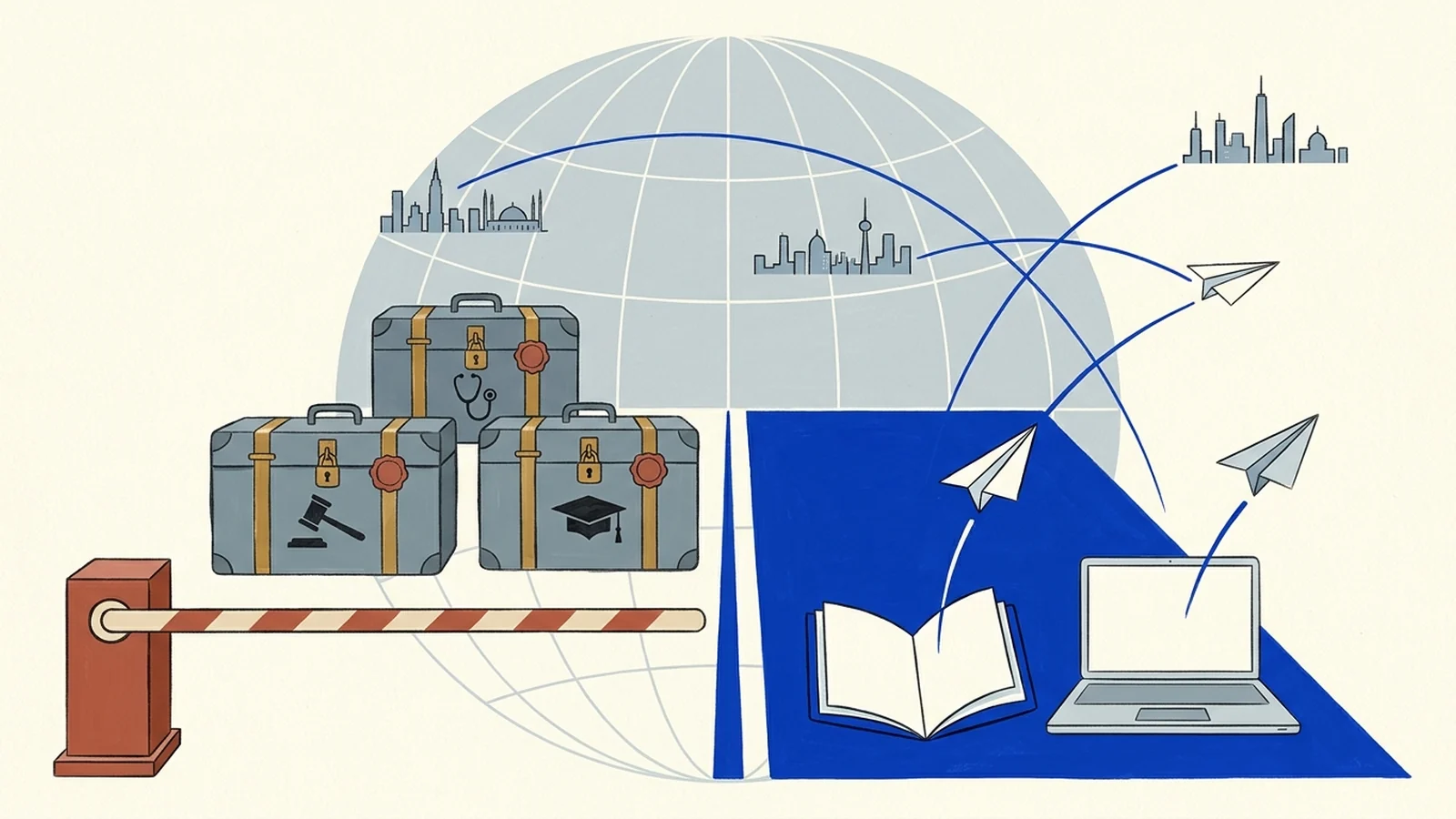
Across 3,119 global occupations scored across nine ISCO-08 civilian groups, only 40.6% (1,266 roles) can be performed remotely across borders without physical site lock-in or formal regulatory restriction. More than half of the global job map remains anchored to one location: 1,734 occupations (55.6%) are location-locked by equipment, premises, or face-to-face delivery.
Portability drops steeply down the occupational ladder. Managers lead at 74.6% borderless share (261 of 350 roles), followed by Professionals at 67.6% (612 of 905) and Technicians and Associate Professionals at 55.4% (382 of 689). Clerical support falls to 12.4%, while Service, Agricultural, Craft Trades, Machine Operators, and Elementary occupations hit 0.0%.
| ISCO-08 Group | Total | Borderless | Share | ESCO Regulated | Median Pay |
|---|---|---|---|---|---|
| 1. Managers | 350 | 261 | 74.6% | 0 | $107,230 |
| 2. Professionals | 905 | 612 | 67.6% | 15 | $97,590 |
| 3. Technicians & Associate Professionals | 689 | 382 | 55.4% | 26 | $76,400 |
| 4. Clerical Support Workers | 89 | 11 | 12.4% | 0 | $47,030 |
| 5. Service & Sales Workers | 204 | 0 | 0.0% | 0 | $38,630 |
| 6. Skilled Agricultural & Forestry Workers | 44 | 0 | 0.0% | 0 | $51,130 |
| 7. Craft & Related Trades Workers | 394 | 0 | 0.0% | 0 | $49,400 |
| 8. Plant & Machine Operators | 347 | 0 | 0.0% | 1 | $46,550 |
| 9. Elementary Occupations | 76 | 0 | 0.0% | 0 | $39,150 |
The nine civilian groups cover 3,098 occupations; the remaining 21 roles sit in ISCO-08 Group 0 (Armed Forces), which are sovereign military roles with zero private cross-border mobility.
How we scored cross-border career portability
Most guides to portable careers for moving abroad rely on anecdote. We instead audited 3,039 titles from the ESCO v1.2.1 classification plus 80 frontier digital roles under the ILO ISCO-08 occupation framework, joined with O*NET 31.0 Work Context physical flags and U.S. Bureau of Labor Statistics 2025–2035 projections.
Four structural gates divide those 3,119 occupations:
- Physical on-site gate: 1,582 roles (50.7%) require physical equipment, clinics, vehicles, or job sites.
- Location-locked flag: 1,734 roles (55.6%) are tied to local premises or in-person service.
- Degree gate: 1,433 roles (45.9%) require a bachelor's degree or higher, triggering visa credential checks.
- Borderless remote share: 1,267 roles (40.6%) are remote-capable; excluding the single remote-capable title carrying ESCO's EU regulated tag leaves 1,266 borderless roles (40.6%).
One boundary matters before relocating. ESCO's formal regulated flag marks only 42 explicitly EU-level regulated titles in this dataset. Real-world statutory licensing is much broader and enforced nationally or by state: bar exams, medical boards, CPA conversions, pharmacy registries, and public K-12 teaching licenses vary by country.
This index therefore separates structural physical lock-in (1,582 physical and 1,734 location-locked roles) from country-level statutory licensing (medicine, law, accounting, pharmacy, and teaching). Always verify host-country rules in the European Commission Regulated Professions Database or the local licensing authority.
The three structural locks that trap a career inside one country
When professionals struggle to transfer careers internationally, the barrier almost always traces to one of three locks. Identifying your lock determines whether you need a remote employer, a conversion exam, or an unlicensed pivot.
Portability Rate by ISCO-08 Occupation Group
Borderless Share (%) Across 7 Major Global Occupation Groups
Managers
74.6%
$107.2k
261 / 350
Professionals
67.6%
$97.6k
612 / 905
Technicians
55.4%
$76.4k
382 / 689
Clerical
12.4%
$47.0k
11 / 89
Service & Sales
0.0%
$38.6k
0 / 204
Trades & Craft
0.0%
$49.4k
0 / 394
Operators
0.0%
$46.6k
0 / 347
Physical and equipment binding
The steepest drop separates ISCO groups 1 through 3 from groups 5 through 9. Managers ($107,230), Professionals ($97,590), and Technicians ($76,400) deliver digital outputs: code, risk models, engineering specifications, and operational plans. Service workers ($38,630), craft trades ($49,400), and operators ($46,550) work directly on physical systems or local customers.
Physical lock-in blocks remote execution, though skilled tradespeople still emigrate via shortage visas in Canada, Australia, and Germany. Even with a visa, electricians and mechanics typically complete local code exams before independent work.
Statutory licensing and public liability
Governments restrict roles where mistakes endanger health, safety, fiduciary trust, or minors. A degree verifies training, whereas a sovereign board grants legal authority to prescribe drugs, appear in court, sign statutory audits, or lead public classrooms. Physicians ($256,560) and lawyers ($159,670) can see licensed practice drop to zero overnight across a border until they pass local boards.
Local legal, tax, and language systems
Unlicensed roles still lose portability when bound to domestic rules or idiomatic local sales. Payroll officers, tax preparers, and real estate brokers hold country-specific knowledge that resets abroad. Language adds a second wall: engineering and software teams hire widely in English across Amsterdam, Berlin, and Singapore, whereas PR and regional sales demand C1 local fluency.
Tier 1 borderless careers with high pay and strong growth
Tier 1 portable roles run on universal technical standards, carry no statutory licensing barrier for corporate employment, and stay in demand across global hiring hubs. These 12 flagship roles come directly from our top borderless dataset, each paying over $100,000 in U.S. BLS median wages with 2025–2035 growth from +7.2% to +34.6%.
| Occupation | ISCO Group | Median Pay | 2025–2035 Growth | AI Exposure | Typical Education |
|---|---|---|---|---|---|
| ICT operations manager | Managers | $175,140 | +15.8% | 44% | Bachelor's degree |
| Embedded systems software developer | Professionals | $135,980 | +10.2% | 57% | Bachelor's degree |
| Software architect | Professionals | $135,980 | +10.2% | 53% | Bachelor's degree |
| ICT network architect | Professionals | $134,050 | +7.7% | 52% | Bachelor's degree |
| Electric power generation engineer | Professionals | $120,630 | +9.9% | 31% | Bachelor's degree |
| Power electronics engineer | Professionals | $120,630 | +9.9% | 42% | Bachelor's degree |
| Computer vision engineer | Professionals | $120,230 | +34.6% | 49% | Bachelor's degree |
| Knowledge engineer | Professionals | $120,230 | +34.6% | 49% | Bachelor's degree |
| Actuarial consultant | Professionals | $117,330 | +7.4% | 56% | Bachelor's degree |
| Insurance risk consultant | Technicians & Assoc. | $117,330 | +7.4% | 53% | Bachelor's degree |
| Financial analyst | Professionals | $102,740 | +7.2% | 62% | Bachelor's degree |
| Dependability engineer | Professionals | $102,440 | +12.4% | 30% | Bachelor's degree |
Two patterns stand out. First, specialized engineering roles tied to energy and reliability, including electric power generation ($120,630, AI exposure 31%) and dependability engineering ($102,440, AI exposure 30%), travel well on ISO and IEC standards while carrying much lower generative AI overlap than financial analysis (62%).
Second, high borderless portability often brings higher automation exposure because digital tasks travel across borders and models alike. Before targeting any remote profession, test its task-level automation score with our AI job risk checker.
Tier 2 semi-portable careers with conversion exams and MRAs
Between borderless jobs and locally trapped titles sit semi-portable professions backed by Mutual Recognition Agreements (MRAs) or structured conversion exams. Plan 6 to 24 months of verification and testing before billing under your licensed title abroad.
- Engineering (Washington Accord): Accredited four-year degrees from signatory countries, including the U.S., U.K., Canada, Australia, Ireland, Japan, and Singapore, receive academic equivalence. Private industrial and R&D engineers often start immediately, while stamping public civil plans requires local chartered or P.Eng registration.
- Accounting and audit (IFRS and MRAs): International Financial Reporting Standards operate across more than 140 jurisdictions, supporting corporate finance mobility. U.S. CPAs, Canadian CPAs, CA ANZ, and ICAEW members can often use reciprocal MRAs or the IQEX exam to shorten public-practice conversion, though domestic tax codes stay local.
- Law (cross-border qualification): Common-law corridors allow foreign-qualified attorneys to sit the Solicitors Qualifying Examination (SQE) in England and Wales or qualify for the New York Bar via an accredited U.S. LL.M. Civil-law attorneys relocating to common-law hubs typically enter faster through in-house commercial or privacy roles.
- EU automatic recognition (Directive 2005/36/EC): Across the EEA and Switzerland, seven sectoral professions (doctors, general care nurses, dentists, veterinarians, midwives, pharmacists, and architects) share harmonized training rules, leaving B2 or C1 medical language exams as the main gate.
Unlicensed cross-border bypasses for five regulated professions
Moving outside a reciprocal treaty zone does not force a multi-year career pause. Regulated professions build deep analytical, operational, and scientific skills that private employers hire internationally without local clinical, bar, or classroom licenses.
The table below maps five heavily licensed professions to 15 verified unlicensed adjacent pivots, using exact BLS 2025 median wages, 2025–2035 growth rates, and O*NET remote work context.
| Licensed Source Role (Pay, Growth) | Unlicensed Adjacent Pivot | Pivot Pay | 2035 Growth | Remote | Cross-Border Transition Path |
|---|---|---|---|---|---|
| Physicians ($256,560, +4.0%) | Medical & health services managers | $123,860 | +24.2% | Yes | Clinical trial ops, digital health, hospital administration. |
| Medical scientists (non-epi) | $103,410 | +12.6% | No | Pharma R&D, biotech medical affairs, clinical research. | |
| Health information technologists | $68,020 | +15.9% | Yes | EHR architecture, clinical coding, health data governance. | |
| Lawyers ($159,670, +4.7%) | General & operations managers | $105,770 | +5.0% | Yes | Commercial ops, vendor contracting, corporate policy. |
| Management analysts | $101,860 | +10.1% | Yes | Governance consulting, M&A integration, process redesign. | |
| Compliance officers | $80,730 | +3.8% | Yes | AML, GDPR privacy, export controls, corporate ethics. | |
| Accountants & auditors ($83,680, +5.0%) | Financial managers | $166,570 | +9.7% | Yes | Corporate treasury, FP&A leadership, regional CFO track. |
| Data scientists | $120,230 | +34.6% | Yes | Pair financial modeling with SQL, Python, and risk analytics. | |
| Financial & investment analysts | $102,740 | +7.2% | Yes | Equity research, valuation, cross-border M&A advisory. | |
| Secondary teachers ($72,040, -0.2%) | Technical writers | $90,390 | +0.8% | No | Convert lesson structure into SaaS docs, SOPs, and guides. |
| Instructional coordinators | $77,440 | +1.6% | Yes | Global edtech curriculum design and learning architecture. | |
| Training & development specialists | $69,280 | +10.8% | Yes | Corporate onboarding, sales enablement, global L&D. | |
| Pharmacists ($140,910, +5.2%) | Medical & health services managers | $123,860 | +24.2% | Yes | Pharmacy benefit ops, clinical supply chains, biotech ops. |
| Medical scientists (non-epi) | $103,410 | +12.6% | No | Pharmacovigilance, clinical trials, drug safety research. | |
| Compliance officers | $80,730 | +3.8% | Yes | FDA/EMA regulatory affairs and GMP quality assurance. |
The pay dynamics diverge sharply by profession. For accountants and auditors ($83,680), stepping out of domestic statutory filing raises median pay across every pivot: financial managers ($166,570), data scientists ($120,230, +34.6% growth), and financial analysts ($102,740) are all remote-capable. For secondary school teachers ($72,040, -0.2% projected contraction), moving into technical writing ($90,390) or instructional coordination ($77,440) lifts income while eliminating state licensing walls. Technical writing is flagged non-remote in O*NET's baseline because defense and manufacturing teams work on-site, though SaaS documentation roles frequently hire remotely.
Physicians and pharmacists accept lower median pay outside licensed practice, yet medical and health services management ($123,860, +24.2% growth) and pharmaceutical compliance ($80,730) preserve strong career trajectory without repeating foreign boards. For broader transition routes across 15 everyday jobs, see our guide to skill-matched career pivots from common jobs.
Five-step pre-move career portability audit
Run this five-step check at least six months before giving notice or signing a lease abroad.
1. Confirm employment structure and tax residency
Remote work is still illegal abroad without local payroll compliance. Confirm whether your employer holds a local entity, uses an Employer of Record (EOR), or allows B2B contracting, and verify 183-day tax residency rules and permanent-establishment triggers.
2. Separate protected titles from protected acts
Check your occupation in the host country's national registry. Distinguish protected titles ("Registered Architect", "Advocate") from protected acts (prescribing medication or signing statutory audits). Many specialists start legally on day one in adjacent corporate roles while studying for conversion exams.
3. Verify the real language CEFR threshold
Multinational tech, pharma, and finance teams in Zurich, Amsterdam, or Berlin often hire at English C1, while domestic firms require local B2 or C1 fluency. Audit 20 live local postings before assuming English is sufficient.
4. Replace domestic credentials with portable proof
Overseas hiring managers rarely know regional employers or local acronyms. Rewrite your resume around universal proof: GitHub commits, P&L budgets in USD or EUR, clinical trial phases delivered, or ISO and IFRS standards owned. To align your work style with an adjacent track before building a portfolio, take a career personality assessment or compare options in our review of the best career test websites.
5. Recalculate local net purchasing power
U.S. wages are global outliers. A software architect earning $135,980 in the U.S. may see local offers near EUR 85,000 in Berlin or GBP 90,000 in London under different tax and healthcare systems. Compare post-tax savings capacity instead of converting gross U.S. salaries at spot rates.
Frequently asked questions
- What percentage of occupations can be performed remotely across borders?
- In our 2026 audit of 3,119 ESCO and frontier occupations, 40.6% (1,266 roles) qualify as borderless and remote-capable without physical lock-in or an ESCO EU regulatory restriction. Another 55.6% (1,734 roles) are structurally location-locked.
- Which job groups have the highest international portability?
- ISCO-08 Group 1 (Managers) leads at 74.6% (261 of 350 roles, $107,230 median pay). Professionals rank second at 67.6% (612 of 905, $97,590), followed by Technicians and Associate Professionals at 55.4% (382 of 689, $76,400).
- Can doctors, lawyers, or pharmacists work abroad without re-licensing?
- They cannot diagnose patients, represent clients in court, or dispense controlled drugs abroad without local licensing. They can move immediately into unlicensed adjacent roles including medical and health services management ($123,860), medical science ($103,410), management analysis ($101,860), and compliance ($80,730).
- Why do service, craft trades, and operator jobs score 0% for borderless remote portability?
- These five groups require physical handling of equipment, facilities, or in-person customers, so they cannot run remotely across borders. Tradespeople can still emigrate on shortage visas after completing local safety tickets or trade assessments.
- Does ESCO's regulated flag capture every country-level license requirement?
- No. ESCO's formal
regulatedflag marks 42 EU-level regulated titles in this dataset, whereas licensing for medicine, law, accounting, pharmacy, and public teaching is enforced nationally or by state. Always confirm protected titles and acts with your destination regulator.
See how these numbers apply to your own profile
Take the free 5–10 minute branching assessment or look up any of 3,119 occupations in the AI Job Risk index.
More notes
Field Benchmark18 min read
10 Best Career Test Websites in 2026: Tested Side by Side
Field Experiment12 min read
ChatGPT vs. Data-Backed Career Tests in 2026: Five Real Profiles Tested Side by Side
Career Data Study13 min read
15 Common Jobs People Want to Leave and Their Highest-Paying Skill-Matched Pivots
Labor Market Study12 min read
Entry-Level Careers Surviving AI in 2026: Best Zero-Experience Roles Ranked by Growth and Pay